
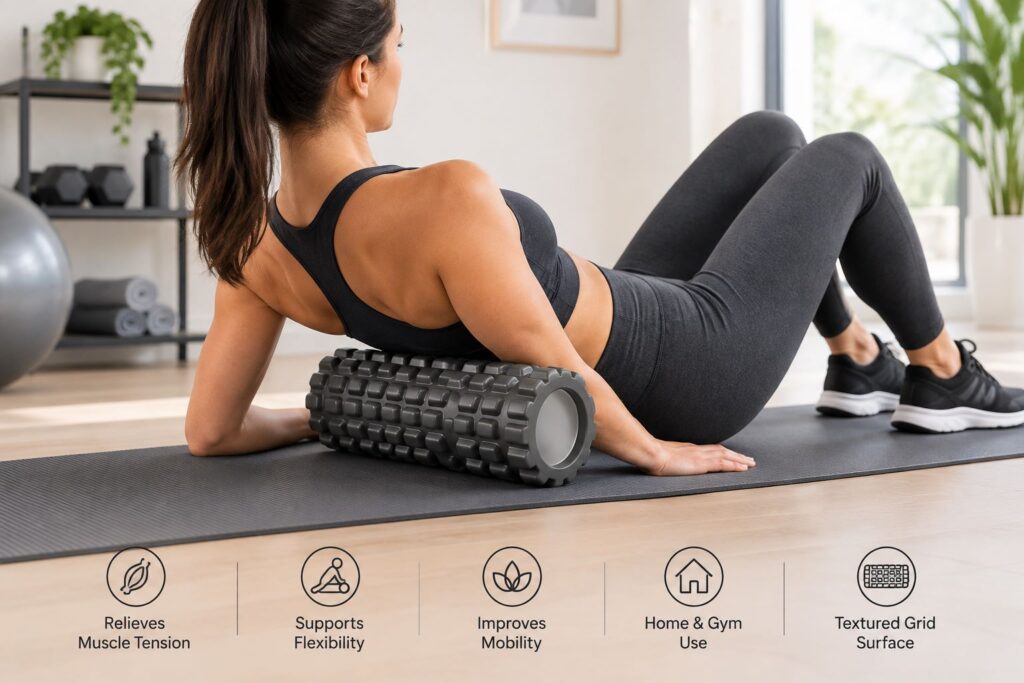
A home workout does not have to end when you put your exercise mat away. Adding a foam roller to your routine can give you another way to explore gentle self-massage, stretching, and mobility exercises.
Whether you enjoy yoga, Pilates, strength training, or simple home workouts, learning how to use a foam roller can help you build a more varied fitness routine.
What Is a Foam Roller?
A foam roller is a cylindrical fitness tool used to apply controlled pressure to selected areas of the body. People commonly include foam rolling in warm-ups, cool-downs, stretching sessions, and general mobility routines.
Foam rollers come in different materials, lengths, and textures. A straightforward EVA foam roller can be a practical option for people who want a versatile accessory for home workouts.
3 Simple Ways to Use a Foam Roller
1. Calf Rolling
Sit on the floor with your legs extended and place the roller beneath one calf. Use your hands to support your body and gently move the calf over the roller.
Start with light pressure and slow movements. Avoid rolling directly over your knee or pressing on painful areas.
2. Thigh Rolling
Position the roller beneath the front of one thigh while supporting your upper body with your hands or forearms. Move slowly over a comfortable range.
Keep the pressure manageable, especially if you are new to foam rolling. You do not need to push through pain to make the exercise useful.
3. Upper-Back Rolling
Lie on your back with the roller positioned beneath your upper back. Keep your knees bent and your feet flat on the floor.
Support your head and neck, then make small, controlled movements. Avoid rolling directly over your neck or lower back.
How Long Should You Use a Foam Roller?
If you are a beginner, start with short sessions and gentle pressure. Move slowly, breathe normally, and pay attention to how your body feels.
There is no need to spend a long time on one area. A few controlled movements can be enough to learn the technique and decide whether it suits your routine.
Stop if you experience sharp pain, numbness, tingling, or unusual discomfort. If you have an injury or a medical condition that may affect exercise, seek guidance from a qualified healthcare professional before trying foam rolling.
How to Choose the Right Foam Roller
Before choosing a foam roller, consider these practical points:
- Length: A shorter roller is easier to store and can be convenient for targeted exercises. A longer roller provides more surface area for certain movements.
- Material: Consider the material and firmness that feel comfortable for your intended routine.
- Purpose: Think about whether you will mainly use it for mobility work, stretching, yoga, Pilates, or general fitness.
- Storage: If you exercise in a small space, choose equipment that is easy to put away after your workout.
The best option is one that fits your available space, exercise habits, and comfort level.
Add a Foam Roller to Your Home Workout Setup
If you are looking for a simple accessory for stretching and mobility sessions, explore the EVA Foam Roller for Muscle Massage, Yoga & Pilates at WorkoutHub.
It is available in 33 cm and 45 cm lengths, with a compact cylindrical design for home or gym routines. Check the product page for the currently available size and color options before ordering.
Explore the EVA Foam Roller at WorkoutHub
Final Thoughts
Building a home fitness routine is often about finding practical tools you can use consistently. A foam roller can be one option for adding self-massage and mobility movements to your routine.
Start gently, learn the basic techniques, and choose equipment that suits your space and fitness goals.
WorkoutHub shares practical information to help readers explore home fitness equipment and workout routines. This article is for general educational purposes and is not a substitute for individualized medical advice.